
Haier Chromebook 11
Updated on

Note: This Chromebook has been discontinued and is no longer available for purchase new. Its Auto Update Expiration date was June 2020, meaning it no longer receives Chrome OS updates or security patches.
The Haier Chromebook 11 launched in March 2015 at $149, one of the first Chromebooks to land well under $200 without giving up usable performance. Haier, a Chinese appliance manufacturer better known for refrigerators and washing machines, partnered with Google and Rockchip to build it, and Amazon sold it exclusively in the United States. Its twin sibling, the Hisense Chromebook 11, launched the same day with the same Rockchip RK3288 reference design but went exclusively to Walmart, so the two retailers each got their own ARM Chromebook at the same $149 price.
| Pros | Cons |
|---|---|
| Ultra-low $149 launch price | Only 2GB RAM with no upgrade option |
| All-day 10-hour battery life | 16GB storage fills quickly |
| Completely silent fanless design | TN display with poor viewing angles |
| 802.11ac WiFi included | USB 2.0 only (no USB 3.0) |
| Lightweight 2.4-pound body | ARM processor limited app compatibility |
| Quick Chrome OS boot times | No Chrome OS updates after June 2020 |
Related Videos
Haier Chromebook 11 Comparison Chart
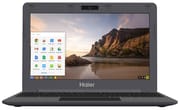 Haier Chromebook 11 | |
| Price | List Price: $149.00 Amazon Prices: |
| Model number | Chromebook 11 |
| Performance Rating | 2.0 |
| Chromebook Plus | No |
| Processor | Quad-core 1.80 Ghz Rockchip RK3288 |
| RAM | 2 GB |
| Internal Storage | 16 GB eMMC |
| Screen Size | 11.6" |
| Screen Resolution | 1366x768 |
| Screen Type | TN |
| Touch Screen | No |
| Stylus / Pen | No Stylus Support |
| Dimensions width x length x thickness | 8.07 x 11.4 x 0.77 inches (204.98 x 289.56 x 19.56 mm) |
| Weight | 2.4 lbs (1.09 kg) |
| Backlit Keyboard | No |
| Webcam | No Webcam |
| WiFi | 802.11 a/b/g/n/ac |
| Bluetooth | Bluetooth 4.0 |
| Ethernet | No |
| Cellular Modem | No |
| HDMI | Full-Size HDMI |
| USB Ports | 2 USB 2.0 |
| Thunderbolt Ports | No |
| Card Reader | microSD Card Reader |
| Battery | Lithium-ion |
| Battery Life | 10.0 hours |
| Fanless | Yes |
| Auto Update Expiration Date | June, 2020 |
Related Chromebooks
-
 Acer Chromebook 311 (AMD)The Acer Chromebook 311 (CB311-10H) is an 11.6-inch ChromeOS laptop on an AMD A4-9120C with 4GB of…
 -
 ASUS Chromebook C203XAThe ASUS Chromebook C203XA is a rugged 11.6-inch education laptop with a MediaTek MT8173C, an…
 -
 Acer Chromebook Spin 11 CP311The Acer Chromebook Spin 11 combines functionality and portability with its 11.6-inch touch IPS…
 -
 Lenovo Flex 3 ChromebookThe Lenovo Flex 3 Chromebook is a fanless 11.6-inch convertible with an IPS touchscreen, a MediaTek…
 -
 Dell Chromebook 3120The Dell Chromebook 3120 is a fanless 11.6-inch education Chromebook with an Intel N100, sold in…
 -
 Lenovo Chromebook 3 11"The Lenovo Chromebook 3 11 is a fanless 11.6-inch Chromebook with an Intel Celeron N4020, 4GB of…
Rockchip ARM silicon with a hard 2GB ceiling
The Rockchip RK3288 is a quad-core ARM Cortex-A17 clocked at 1.8GHz, paired with an ARM Mali-T764 GPU. It was one of the few ARM parts certified for Chrome OS at the time, when Intel Celeron chips ran most of the budget market. Power draw was low enough for fanless cooling and a long battery life, at the cost of raw speed and software compatibility.
For basic Chromebook tasks like web browsing, Google Docs, and email, the RK3288 proved adequate. Chrome OS’s lightweight architecture helped mask the processor’s limitations, and the fanless cooling meant completely silent operation. However, opening many browser tabs simultaneously or running complex web applications revealed the 2GB RAM limitation. The 16GB eMMC storage filled quickly, making cloud storage essential for any meaningful file management.
The wireless radio is 802.11ac, and Bluetooth 4.0 covers a mouse or a headset. A full-size HDMI type A port drives an external monitor with no adapter and no dock, and the microSD slot takes some pressure off the 16GB of onboard storage.
A 1366x768 TN panel in a 2.4-pound plastic shell
Resolution is 1366x768 on an 11.6-inch TN (Twisted Nematic) panel. Colors wash out when you look from the side, so one person sitting square to the screen gets the good view and anyone leaning in from a chair beside it does not. The screen is not a touchscreen, which kept the cost down and rules out the tablet and tent modes a convertible offers.
The machine weighs 2.4 pounds and measures 11.4 x 8.07 x 0.77 inches, so it slides into a backpack sleeve without much thought. The shell is plastic throughout, chosen for price rather than feel. The chiclet keyboard types well enough for light use, and there is no backlight, so a dark room means working from memory.
Ports are two USB 2.0, full-size HDMI, a combination headphone and microphone jack, and a microSD card reader. Neither USB port is 3.0, so an external drive copies at the older transfer speed no matter how fast the drive itself is.
The sub-$200 push that produced two identical twins
Google was expanding Chromebook options at lower price points to drive adoption in education and emerging markets. Working with Rockchip let manufacturers build below the $200 threshold, which Intel’s platform could not match at the time.
Released simultaneously with the Hisense Chromebook 11, the two devices shared the same underlying reference design from Rockchip. Both featured the RK3288 processor, 11.6-inch displays, and similar specifications, though minor variations existed in battery capacity and exact dimensions. This dual-launch strategy from previously unknown brands suggested Google’s orchestration in bringing budget Chrome OS devices to market.
When Android apps came to Chrome OS starting in 2016, the RK3288’s ARM architecture initially seemed advantageous since Android was designed for ARM. However, many Chrome OS optimizations and enterprise management features were developed primarily for Intel platforms, and the RK3288’s eventual support proved limited compared to Intel-based models. By the time the Haier reached its 2020 AUE date, Google had already shifted its low-end Chromebook strategy away from Rockchip and toward MediaTek’s Kompanio family and Intel’s Apollo Lake / Gemini Lake Celerons, so the RK3288 generation was effectively a one-off chapter in ARM Chromebook history rather than a long-running platform.
Offline chores are the only safe use left
Anyone still hanging on to a working Haier Chromebook 11 in 2026 is six years past the official Chrome OS update cutoff, which means no patches for newly disclosed browser vulnerabilities, no certificate-store updates, and an increasingly fragile relationship with modern HTTPS-only sites. The device still boots and still loads pages, but it should not be trusted with anything that asks for a password to a real account: email, banking, shopping carts, or anything tied to a recovery phone number. Used purely as a kitchen recipe reader, a kid’s typing-practice machine, or an offline document reader plugged into a CRT or projector via its full-size HDMI port, it still has a niche.
The repurposing options here are narrower than for the Bay Trail-based Haier Chromebook 11 G2 that replaced it: ChromeOS Flex requires an x86_64 CPU and explicitly does not run on ARM hardware, so Flex is off the table entirely. The RK3288 can boot mainline Linux distributions (Debian, Arch Linux ARM) through community ports of the Veyron-Jaq mainboard variant the Haier uses, but driver coverage for the panel, touchpad, and audio is uneven and the install path requires unlocking firmware write protect and flashing custom U-Boot via the Mr Chromebox script. The reward for the effort is a 2GB ARM laptop that still has the same RAM and storage ceilings it shipped with in 2015.
For most owners the choice in 2026 comes down to offline single-purpose use or responsible e-waste recycling. The 2.4 lb chassis weighs little, the lithium-ion pack has an end-of-life that should not go in household trash, and most U.S. municipalities offer free e-waste drop-off that will accept Chromebooks intact. The Haier brand’s exit from the U.S. Chromebook market years ago means there is no manufacturer trade-in program to lean on.
Coverage was thin and mostly on video
Lon Seidman of Lon.TV recorded one of the most-watched video reviews, titled “Haier Chromebook 11 Review: $150 11 inch Chromebook with new Rockchip RK3288 processor”, which still appears as the top hit when searching for this device today. The video came out within weeks of launch and runs through the chassis, ports, and Chrome OS performance on the new Rockchip part.
The Dr Earbuds channel produced three short video pieces on the device that taken together cover unboxing, day-to-day review, and a head-to-head against the Hisense twin. In the dedicated review (video 3fY83NkrTVQ) the host describes it as “the hair chromebook review now this is an exclusive chromebook to amazon” and notes that “it is rocking the rock chip processor in the same processor that’s in the asus chromebook flip” (referring to the Rockchip RK3288 used in the ASUS Chromebook Flip C100PA). The Haier vs Hisense comparison piece (NXl7XnYOpns) sets out the dual-launch retail strategy: “this is the high sense versus the hair Chromebook this is Walmart’s entry level Chromebook made by hense … and this is Amazon’s version this is the hair Chromebook.” The same video covers the memory and CPU: “the hair is powered by The Rock Chip processor … both Rock in 2 gigs of RAM.”
Each twin went to a single retailer, and Haier had almost no brand recognition in the US computer market, which held the review count down. Most tech publications focused their budget Chromebook coverage on the simultaneously released Hisense model or on offerings from more established manufacturers like Acer and ASUS.
Those comparing the Haier to modern budget options will find the Chromebook Comparison Chart useful for sorting current models by price, specs, and support status side by side.
Frequently Asked Questions
Q: Can I still use the Haier Chromebook 11 in 2026?
A: It still boots and still loads pages, but Chrome OS updates stopped in June 2020. That means no security patches, no new features, and sites that drift out of compatibility as web standards move. Keep it away from online banking and anything else that needs a password you care about.
Q: What processor does the Haier Chromebook 11 use?
A: It runs the Rockchip RK3288, a quad-core ARM Cortex-A17 at 1.8GHz with an ARM Mali-T764 GPU, one of the few ARM chips certified for Chrome OS at the time.
Q: What is the difference between the Haier Chromebook 11 and Hisense Chromebook 11?
A: The Haier and the Hisense Chromebook 11 launched in March 2015 on the same Rockchip RK3288 reference design, with the same processor, 11.6-inch displays, and near-identical specifications. Battery capacity and exact dimensions varied slightly; performance did not.
Q: How long does the Haier Chromebook 11 battery last?
A: It was rated for approximately 10 hours. The Rockchip ARM chip draws little enough power to carry a day of web browsing and document work on one charge.
Q: Why was the Haier Chromebook 11 so inexpensive?
A: Four things held the price to $149: the Rockchip ARM processor cost less than Intel alternatives, 2GB of RAM and 16GB of storage kept component costs down, the TN display was cheaper than an IPS panel, and Haier’s manufacturing scale in China kept production costs low. Selling only through Amazon also trimmed retail markup.
Q: Could Android apps run on the Haier Chromebook 11?
A: Only partly. Chrome OS added Android app capability later, but the RK3288 got inconsistent support for the feature, and the device was never officially listed among Chrome OS models with full Android app support.