
Samsung Galaxy Chromebook Go 14"
Updated on

The Samsung Galaxy Chromebook Go 14” is an entry-level Chromebook built for portability and durability rather than speed. The plastic shell weighs 3.2 pounds in a “timeless silver” finish that looks modest and travels well. Optional LTE connectivity lets you work without hunting for a Wi-Fi hotspot. Wi-Fi 6 and MIL-STD-810G durability certification round out a Chromebook meant to survive a backpack and a full day away from a charger.
Pros and Cons
| Pros | Cons |
|---|---|
| Lightweight at 3.2 lbs (1.45kg) | Low-resolution 1366x768 display with poor viewing angles |
| Optional LTE connectivity for mobile use | Sluggish performance with heavy multitasking |
| MIL-STD-810G durability rating | No HDMI output for external displays |
| Spill-resistant keyboard | Non-backlit keyboard limits low-light use |
| Up to 12 hours of battery life | 4GB of RAM on most configurations |
| Wi-Fi 6 and Bluetooth 5.1 support | Muffled speakers, per T3 |
Related Videos
Samsung Galaxy Chromebook Go 14" Comparison Chart
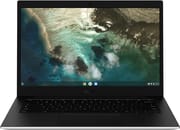 Samsung Galaxy Chromebook Go 14" | Samsung Galaxy Chromebook Go 14" | Samsung Galaxy Chromebook Go 14" | Samsung Galaxy Chromebook Go 14" | Samsung Galaxy Chromebook Go 14" | Samsung Galaxy Chromebook Go 14" | |
| Price | List Price: $349.99 Amazon Prices: Loading prices... | List Price: $349.99 Amazon Prices: Loading prices... | List Price: $349.99 Amazon Prices: Loading prices... | List Price: $299.99 Amazon Prices: Loading prices... | List Price: $179.00 Amazon Prices: Loading prices... | List Price: $329.99 Amazon Prices: |
| Model number | XE345XDA-LA1VZ | XE340XDA-KA6US | XE345XDA-NA1TT | XE340XDA-KA1US | XE340XDA-KA2US | XE340XDA-KA8US |
| Performance Rating | 2.6 | 3.7 | 2.6 | 2.6 | 2.6 | 2.6 |
| Chromebook Plus | No | No | No | No | No | No |
| Processor | Dual-core 1.10 Ghz (max 2.80 Ghz) Intel Celeron Processor N4500 | Dual-core 1.10 Ghz (max 2.80 Ghz) Intel Celeron Processor N4500 | Dual-core 1.10 Ghz (max 2.80 Ghz) Intel Celeron Processor N4500 | Dual-core 1.10 Ghz (max 2.80 Ghz) Intel Celeron Processor N4500 | Dual-core 1.10 Ghz (max 2.80 Ghz) Intel Celeron Processor N4500 | Dual-core 1.10 Ghz (max 2.80 Ghz) Intel Celeron Processor N4500 |
| RAM | 4 GB | 8 GB | 4 GB | 4 GB | 4 GB | 4 GB |
| Internal Storage | 32 GB eMMC | 32 GB eMMC | 32 GB eMMC | 32 GB eMMC | 64 GB eMMC | 128 GB eMMC |
| Screen Size | 14" | 14" | 14" | 14" | 14" | 14" |
| Screen Resolution | 1366x768 | 1366x768 | 1366x768 | 1366x768 | 1366x768 | 1366x768 |
| Screen Type | 220 nits, anti-glare | 220 nits, anti-glare | 220 nits, anti-glare | 220 nits, anti-glare | 220 nits, anti-glare | 220 nits, anti-glare |
| Touch Screen | No | No | No | No | No | No |
| Stylus / Pen | No Stylus Support | No Stylus Support | No Stylus Support | No Stylus Support | No Stylus Support | No Stylus Support |
| Dimensions width x length x thickness | 12.88 x 8.88 x 0.63 inches (327.15 x 225.55 x 16 mm) | 12.88 x 8.88 x 0.63 inches (327.15 x 225.55 x 16 mm) | 12.88 x 8.88 x 0.63 inches (327.15 x 225.55 x 16 mm) | 12.88 x 8.88 x 0.63 inches (327.15 x 225.55 x 16 mm) | 12.88 x 8.88 x 0.63 inches (327.15 x 225.55 x 16 mm) | 12.88 x 8.88 x 0.63 inches (327.15 x 225.55 x 16 mm) |
| Weight | 3.2 lbs (1.45 kg) | 3.2 lbs (1.45 kg) | 3.2 lbs (1.45 kg) | 3.2 lbs (1.45 kg) | 3.2 lbs (1.45 kg) | 3.2 lbs (1.45 kg) |
| Backlit Keyboard | No | No | No | No | No | No |
| Webcam | HD | HD | HD | HD | HD | HD |
| WiFi | Wi-Fi 6 (Gig+), 802.11ax 2x2 | Wi-Fi 6 (Gig+), 802.11ax 2x2 | Wi-Fi 6 (Gig+), 802.11ax 2x2 | Wi-Fi 6 (Gig+), 802.11ax 2x2 | Wi-Fi 6 (Gig+), 802.11ax 2x2 | Wi-Fi 6 (Gig+), 802.11ax 2x2 |
| Bluetooth | Bluetooth 5.1 | Bluetooth 5.1 | Bluetooth 5.1 | Bluetooth 5.1 | Bluetooth 5.1 | Bluetooth 5.1 |
| Ethernet | No | No | No | No | No | No |
| Cellular Modem | No | No | No | No | No | No |
| HDMI | No HDMI | No HDMI | No HDMI | No HDMI | No HDMI | No HDMI |
| USB Ports | 1 USB 3, 2 USB-C (4K display out with optional adapter, charging) | 1 USB 3, 2 USB-C (4K display out with optional adapter, charging) | 1 USB 3, 2 USB-C (4K display out with optional adapter, charging) | 1 USB 3, 2 USB-C (4K display out with optional adapter, charging) | 1 USB 3, 2 USB-C (4K display out with optional adapter, charging) | 1 USB 3, 2 USB-C (4K display out with optional adapter, charging) |
| Thunderbolt Ports | No | No | No | No | No | No |
| Card Reader | microSD Card Reader | microSD Card Reader | microSD Card Reader | microSD Card Reader | microSD Card Reader | microSD Card Reader |
| Battery | 2 cell, 5480mAh / 42.3Wh, Li-Ion | 2 cell, 5480mAh / 42.3Wh, Li-Ion | 2 cell, 5480mAh / 42.3Wh, Li-Ion | 2 cell, 5480mAh / 42.3Wh, Li-Ion | 2 cell, 5480mAh / 42.3Wh, Li-Ion | 2 cell, 5480mAh / 42.3Wh, Li-Ion |
| Battery Life | 12.0 hours | 12.0 hours | 12.0 hours | 12.0 hours | 12.0 hours | 12.0 hours |
| Fanless | No | No | No | No | No | No |
| Auto Update Expiration Date | June, 2031 | June, 2031 | June, 2031 | June, 2031 | June, 2031 | June, 2031 |
Related Chromebooks
-
 HP Chromebook 14a (14a-nf series)The HP Chromebook 14a (14a-nf series) spans two tiers of the same chassis: an Amazon-exclusive…
 -
 Acer Chromebook 314The Acer Chromebook 314 is a 14-inch budget Chromebook with a 1920x1080 IPS display, an Intel…
 -
 Acer Chromebook 314 (CB314-4H/4HT)A budget-friendly 14-inch Chromebook with Intel Alder Lake-N processors, WiFi 6E, and software…
 -
 HP Chromebook 14 G7The HP Chromebook 14 G7 packs a 14-inch anti-glare WLED screen, Wi-Fi 6, a 720p HD webcam, and…
 -
 Samsung Chromebook 4The Samsung Chromebook 4 is an 11.6-inch Celeron N4000 or N4020 Chromebook with 4GB of RAM, a…
 -
 Samsung Galaxy Chromebook 2The Samsung Galaxy Chromebook 2 is a 13.3-inch 2-in-1 with a vivid 1080p QLED touchscreen, an…
The Budget Cuts Land on the Screen and the Chip
The 1366x768 TN panel has poor color accuracy and viewing angles, which multiple reviewers have criticized as “washed out” and “fuzzy.” Document editing and web browsing look serviceable on it, while photo work and video expose the limits immediately. The anti-glare coating helps in bright rooms, though it cannot compensate for the resolution.
The Intel Celeron N4500 paired with 4-8GB of RAM handles everyday Chrome OS tasks but struggles when pushed. Many open tabs, Android apps, or heavy multitasking reach the hardware ceiling, and reviewers consistently noted delays when launching applications or responding to USB devices. The eMMC storage comes in 32GB, 64GB, or 128GB configurations, quick enough for Chrome OS but short on room for offline files or Android apps.
Samsung fitted a spill-resistant keyboard, which suits a laptop that will live in cafes, classrooms, and on airplane tray tables. Reviewers disagree about the typing itself. Some found it comfortable with good key travel, while others described it as flat and uninspiring. There is no keyboard backlighting, so dim rooms are a problem. The trackpad handles Chrome OS gestures reliably, with responsive taps and multi-finger navigation.
Reviewer Insights
TechRadar awarded it 3 out of 5 stars, summarizing their assessment with “LTE is a bonus; everything else, not so much.” They praised the spacious panel, keyboard layout, and long battery life, but found the screen quality “awful” and the processing power insufficient for demanding tasks. TechRadar also flagged the missing HDMI output for anyone wanting to connect an external display.
T3’s review similarly gave 3 out of 5 stars and highlighted the lightweight 1.45kg design and tactile keyboard as positives. However, they criticized the subpar screen quality, limited performance, and surprisingly muffled audio from the speakers. Their verdict concluded that “The Samsung Galaxy Chromebook Go isn’t going to wow you but it is still worth considering” for users with basic computing needs and tight budgets.
Eric Grevstad from PCMag offered a more critical perspective, writing that its “pitiful 4GB of memory and 32GB of eMMC flash storage are rock bottom even by Chrome OS standards.” He called it “a sluggish performer with a miserably dim, low-resolution screen,” making the experience feel slow compared to similarly-priced alternatives. The Chrome Unboxed team echoed these concerns in their video review, acknowledging that while the Chromebook Go is acceptable, it isn’t the best choice within this price range.
Customer Reviews
Across 14 ratings on Amazon, the Samsung Galaxy Chromebook Go 14” averages 3.9 stars. 59 percent of ratings are five stars while 19 percent are one star, and the handful of written reviews follows the same divide. A reviewer named Eddie Palmon T gave it five stars and pushed back on the complaints, writing that “The screen is usable, and the keyboard is too” and “For the price this is not a bad laptop.”
The two one-star reviews describe different problems. A verified buyer named Barb said the unit did not match its listing, writing “this is not verizon cellular compatable as advertised” and describing repeated trips to the carrier before Samsung confirmed it; she still called it a “nice chromebook” otherwise. A second verified buyer, William, reported an early hardware failure: “this product didn’t even work at all after having it only one day. screen totally went black and would not come back on.” With this few written reviews, treat both as single reports rather than a pattern, and check the cellular compatibility of your specific listing before the return window closes.
Read more owner reviews on Amazon.
A Durable Travel Laptop for Light Web Work
A light, tough laptop with an LTE option, the Chromebook Go trades speed and looks for durability. It suits students carrying a device between classes for note-taking and research, travelers who want LTE more than speed, and anyone who wants a second machine for web tasks. The MIL-STD-810G rating and the spill-resistant keyboard pay off in settings where a laptop takes a beating.
Photo editing and heavy multitasking belong on something else, and anyone who needs HDMI output for presentations or external monitors will find the port selection limiting. Starry Hope’s Chromebook Comparison Chart lines these specs up against other models if you want to weigh the display and processor against other models.
Frequently Asked Questions
Does the Samsung Galaxy Chromebook Go have LTE connectivity?
Yes, the Samsung Galaxy Chromebook Go is available in both Wi-Fi-only and LTE variants. The LTE model (XE345XDA) allows you to connect to cellular networks for internet access anywhere you have mobile coverage, which is unusual for a budget Chromebook.
How long does the battery last on the Galaxy Chromebook Go?
Samsung advertises up to 12 hours of battery life. In TechRadar’s movie-playback battery test, the device lasted 11 hours and 18 minutes, and real-world usage with mixed tasks typically falls between 8-10 hours.
Is the Samsung Galaxy Chromebook Go good for students?
It fits students who work mostly in web applications like Google Docs and school platforms. The light body, long battery life, spill-resistant keyboard, and MIL-STD-810G durability suit classroom and commuting use. Students who run demanding applications or several Android apps at once will hit the performance limits.
Can I connect an external monitor to the Galaxy Chromebook Go?
Yes, you can connect an external display using either of the two USB-C ports with a USB-C to HDMI or USB-C to DisplayPort adapter. The device supports up to 4K display output, though you’ll need to purchase an adapter separately as there’s no built-in HDMI port.
What is the Auto Update Expiration date for the Galaxy Chromebook Go?
The Samsung Galaxy Chromebook Go will receive Chrome OS updates and security patches from Google until June 2031, per Google’s official Auto Update Expiration list. After this date, the device will continue to function but will no longer receive new features or security updates. Learn more about Chromebook Auto Update Expiration.
Is the keyboard backlit on the Galaxy Chromebook Go?
No. The Samsung Galaxy Chromebook Go ships without keyboard backlighting, one of the cost-saving choices behind its price. Typing in a dim room means working by whatever light is already there.
How much storage does the Galaxy Chromebook Go have?
The Galaxy Chromebook Go is available with 32GB, 64GB, or 128GB of eMMC flash storage, depending on the variant. You can expand storage using the built-in microSD card slot, and Chrome OS is designed for cloud-first workflows so local storage is primarily used for offline files and Android apps.