
MINISFORUM MS-01
Updated on

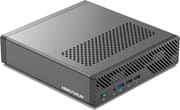
The MINISFORUM MS-01 is a mini PC built around a mobile Intel chip and four network ports. Configurations run from a Core i5-12600H up to a Core i9-13900H with 14 cores and 20 threads, a range that covers virtualization and media transcoding alike. Dual 10GbE SFP+ ports, dual 2.5GbE Ethernet ports, and an official 64GB DDR5 ceiling (one owner reports 96GB working) aim it at home lab builders and anyone who wants a compact workstation with room to grow.
Connectivity covers two USB 4 ports with Thunderbolt support, three M.2 slots for storage, and a PCIe x16 expansion slot wired at x8 speeds. The chassis pairs a dedicated SSD fan with a copper CPU heatsink to hold clocks under sustained load. The PCIe slot accepts only half-height, single-slot cards, and an SSD voltage switch can damage a drive if it is set wrong.
| Pros | Cons |
|---|---|
| Intel Core i9-13900H with 14 cores and 20 threads on the top configuration. | Half-height, half-length PCIe slot rules out many expansion cards. |
| Dual 10GbE SFP+ on an Intel X710 NIC and dual 2.5GbE ports on the Intel i226-LM. | SSD voltage switch poses a risk of damaging drives if misconfigured. |
| Takes up to 64GB of DDR5 RAM across two channels (96GB owner-reported). | NVMe performance bottlenecks when all three M.2 slots are utilized simultaneously. |
| Dedicated SSD fan and a copper CPU heatsink for sustained loads. | No support for two-slot GPUs or high-power PCIe cards. |
| PCIe x16 slot (x8 speeds) allows for expansion with low-profile GPUs or network cards. | Fan noise reaches 42 to 45 dB(A) at full CPU load. |
| Three M.2 slots plus U.2 drive support through the included adapter. | BIOS support for off-label PCIe cards is spotty. |
| vPro remote management on the i226-LM 2.5GbE ports. | Internal access needs tools, which makes upgrades slower than they could be. |
Related Videos
MINISFORUM MS-01 Comparison Chart
 MINISFORUM MS-01 | MINISFORUM MS-01 | MINISFORUM MS-01 | |
| Price | List Price: $589.99 Amazon Prices: Loading prices... | List Price: $687.00 Amazon Prices: | List Price: $1009.99 Amazon Prices: Loading prices... |
| Version | 32GB/1TB/Intel Core i5-12600H | 32GB/1TB/Intel Core i9-12900H | 32GB/1TB/Intel Core i9-13900H |
| Performance Rating | 8.4 | 9.3 | 9.4 |
| Operating System | Windows 11 | Windows 11 | Windows 11 |
| Processor | Twelve-core 3.30 Ghz (max 4.50 Ghz) Intel Core i5-12600H | Fourteen-core 3.80 Ghz (max 5.00 Ghz) Intel Core i9-12900H | Fourteen-core 4.10 Ghz (max 5.40 Ghz) Intel Core i9-13900H |
| GPU | Integrated Intel Iris Xe Graphics | Integrated Intel Iris Xe Graphics | Integrated Intel Iris Xe Graphics |
| RAM | 32 GB | 32 GB | 32 GB |
| Internal Storage | 1 TB | 1 TB | 1 TB |
| Dimensions width x length x thickness | 7.72 x 7.44 x 1.89 inches (196.09 x 188.98 x 48.01 mm) | 7.72 x 7.44 x 1.89 inches (196.09 x 188.98 x 48.01 mm) | 7.72 x 7.44 x 1.89 inches (196.09 x 188.98 x 48.01 mm) |
| Weight | unknown | unknown | unknown |
| WiFi | Wi-Fi 6E (802.11ax) | Wi-Fi 6E (802.11ax) | Wi-Fi 6E (802.11ax) |
| Bluetooth | -- | -- | -- |
| Ethernet | 2 Ethernet ports at 2.5 Gbps | 2 Ethernet ports at 2.5 Gbps | 2 Ethernet ports at 2.5 Gbps |
| HDMI | 1 Full-Size HDMI Port | 1 Full-Size HDMI Port | 1 Full-Size HDMI Port |
| DisplayPort | DisplayPort via USB-4 ports | DisplayPort via USB-4 ports | DisplayPort via USB-4 ports |
| VGA | No VGA Ports | No VGA Ports | No VGA Ports |
| USB Ports | 2 USB 2.0, 3 USB 3, 2 USB-C (2 USB4) 2x USB 4.0 (40Gbps, Alt DP, Thunderbolt), 3x USB 3.0, 2x USB 2.0. USB 4 ports support Thunderbolt devices but do not support power delivery. | 2 USB 2.0, 3 USB 3, 2 USB-C (2 USB4) 2x USB 4.0 (40Gbps, Alt DP, Thunderbolt), 3x USB 3.0, 2x USB 2.0. USB 4 ports support Thunderbolt devices but do not support power delivery. | 2 USB 2.0, 3 USB 3, 2 USB-C (2 USB4) 2x USB 4.0 (40Gbps, Alt DP, Thunderbolt), 3x USB 3.0, 2x USB 2.0. USB 4 ports support Thunderbolt devices but do not support power delivery. |
| Thunderbolt Ports | 2 | 2 | 2 |
| OCuLink | No | No | No |
| Internal SATA Ports | No SATA ports | No SATA ports | No SATA ports |
| Card Reader | No Card Reader | No Card Reader | No Card Reader |
| Headphone Jack | combo | combo | combo |
| Fanless | No | No | No |
| VESA Mount | No | No | No |
| In the Box | 1x MS-01 main unit, 1x power adapter, 1x power cable, 1x U.2 conversion plate, 1x SSD heat sink, 1x mounting screw, 1x HDMI cable, 1x user's manual, 180W power supply, m.2 to SATA adapter. | 1x MS-01 main unit, 1x power adapter, 1x power cable, 1x U.2 conversion plate, 1x SSD heat sink, 1x mounting screw, 1x HDMI cable, 1x user's manual, 180W power supply, m.2 to SATA adapter. | 1x MS-01 main unit, 1x power adapter, 1x power cable, 1x U.2 conversion plate, 1x SSD heat sink, 1x mounting screw, 1x HDMI cable, 1x user's manual, 180W power supply, m.2 to SATA adapter. |
| Expandability | PCIe x16 slot (runs at 8x speeds), supports low-profile GPUs like Radeon RX 6400 or RTX A2000; supports up to 64 GB DDR5 RAM in dual channel (96 GB owner-reported); supports three M.2 NVMe drives and one 2.5-inch SATA drive. Includes m.2 to U.2 adapter board. | PCIe x16 slot (runs at 8x speeds), supports low-profile GPUs like Radeon RX 6400 or RTX A2000; supports up to 64 GB DDR5 RAM in dual channel (96 GB owner-reported); supports three M.2 NVMe drives and one 2.5-inch SATA drive. Includes m.2 to U.2 adapter board. | PCIe x16 slot (runs at 8x speeds), supports low-profile GPUs like Radeon RX 6400 or RTX A2000; supports up to 64 GB DDR5 RAM in dual channel (96 GB owner-reported); supports three M.2 NVMe drives and one 2.5-inch SATA drive. Includes m.2 to U.2 adapter board. |
Related Mini PCs
-
 MINISFORUM Mercury Series EM780The MINISFORUM EM780 is an 80mm-square Ryzen 7 7840U mini PC with Radeon 780M graphics, 32GB of…
 -
 MINISFORUM NAD9The MINISFORUM NAD9 is a Core i9-12900H mini PC with two 2.5-inch SATA bays plus an M.2 NVMe slot,…
 -
 Beelink EQI13 PROThe Beelink EQI13 PRO pairs an Intel Core i7-13620H (10 cores, 16 threads) with 32GB of DDR4 and a…
 -
 Beelink GTi14The Beelink GTi14 pairs an Intel Core Ultra (9 185H or 7 155H) and Arc graphics with up to 96GB…
 -
 GEEKOM XT12 ProThe GEEKOM XT12 Pro is a compact aluminum mini PC with an Intel Core i9-12900H (or i7-12650H), 32GB…
 -
 GMKtec NucBox K11The GMKtec NucBox K11 is a Ryzen 9 8945HS mini PC with Radeon 780M graphics, two DDR5 slots (96GB…
Four network ports and an x8 slot on a mobile-chip platform
The top configuration uses the Intel Core i9-13900H, which combines six performance cores with eight efficiency cores and boosts to 5.4 GHz. Two lower tiers ship the Core i9-12900H and the Core i5-12600H, so the chip in a given unit depends on which build you order. Memory runs up to 64GB of DDR5 across two channels on the spec sheet (one owner reports 96GB working), and storage spans three M.2 slots wired Gen 4x4, Gen 3x4, and Gen 3x2, with U.2 NVMe drives supported through an included adapter.
The dual 10GbE SFP+ ports run on Intel’s X710 NIC and the dual 2.5GbE Ethernet ports on the Intel i226-LM, which is the variant that carries vPro remote management. Two USB 4 ports handle Thunderbolt devices, external displays, and high-speed storage. The PCIe x16 slot runs at x8 speeds and takes low-profile GPUs or additional network cards, though its physical constraints limit it to single-slot, half-height cards, and that ceiling is the main thing to check against your parts list.
Cooling comes from a dedicated fan over the SSDs and a copper heatsink on the CPU, which holds performance under sustained workloads at the cost of audible fan noise. Setup takes some care, because the SSD voltage switch and the tight clearance around the expansion slot both matter before hardware goes in.
Reviewer Insights
The reviews below all tested the top Intel Core i9-13900H configuration. Their numbers describe the ceiling of the lineup rather than the i5-12600H and i9-12900H tiers. The i9-13900H is a Raptor Lake-H mobile part (launched early 2023) that still posts a PassMark CPU Mark near 29,582; even in 2026 that carries a small home lab or a compact workstation comfortably. It is a mobile chip held to firm power and thermal limits.
ServeTheHome: power draw sits above the mini PC norm
In his ServeTheHome video review, Patrick Kennedy put the MS-01 on a power meter in performance mode and measured idle draw at roughly 10 watts at the CPU package and 25 to 30 watts at the wall, which he flagged as “higher than the average mini PC” in the accompanying written review. Under a stress-ng load the package jumped to 80 watts and the wall meter to about 115 watts for the first 45 to 50 seconds, then dialed back to a sustained 60 watts at the package and roughly 90 to 95 watts at the wall to hold thermals in check. Fan noise tracked that curve: 37 to 38 dB(A) at idle against a 34.5 dB(A) studio floor, climbing into the 42 to 45 dB(A) range at 100 percent CPU load. He stated that “this is not an ultra low power system.”
Patrick ran a PCIe “plug-fest” in that low-profile, single-slot, x8-wired slot. A QNAP QM2-2P2G2T2 dual-M.2-plus-dual-2.5GbE card black-screened and never booted after 30 minutes; an Intel quad-port X710 10GbE card physically fouled the SFP+ cage until he removed the rear faceplate; a Broadcom 95740 was simply too long for the chassis; while an Aquantia AQC113C 10Gbase-T card, an NVIDIA Mellanox ConnectX-4 Lx, and a thin-client AMD GPU all worked. He confirmed the dual SFP+ ports run on an Intel X710 NIC and the 2.5GbE ports on the Intel i226-LM (the LM variant enabling vPro remote management), and noted the i9-12900H option sells for about $130 less as a value pick. On the listed i9-13900H tier he priced the bare CPU at roughly $619 inside an $829 system, and concluded, “The Minisforum MS-01 is a really awesome machine.”
NotebookCheck: long load runs ended in unpredictable crashes
NotebookCheck’s full lab review (i9-13900H, 32GB DDR5-5600, May 13, 2024) scored the MS-01 81.5 percent and produced the most complete bench table available. With the processor’s power limits left at the factory PL1 of 60 watts and PL2 of 80 watts, it recorded Cinebench R23 at 16,209 points multi-core and 1,806 single-core, and Geekbench 5.5 at 13,014 multi-core and 1,867 single-core. Power draw measured 14.4 / 16.1 / 25.5 watts (minimum / average / maximum) at idle and averaged 87.3 watts under load with a 123.3-watt peak. Noise sat at 33.7 to 34.7 dB(A) at idle against a 24.4 dB(A) ambient floor, with the reviewers wishing for stronger cooling once the fan opened up.
On thermals NotebookCheck found the chassis stayed below 40 °C, while two P-cores “exceed 90 °C” under load and the package hit 101 °C in a FurMark stress run. The review also flagged a stability problem, reporting that testing “was repeatedly accompanied by unpredictable crashes” during long load runs such as the Cinebench R15 multi-loop, the SSD stress test, and the Adobe Premiere benchmark. Wi-Fi 6E throughput on the 6 GHz band was strong at roughly 1,753 Mbit/s receive and 1,775 Mbit/s transmit. NotebookCheck concluded that “The Minisforum MS-01 is not an economical device,” yet on raw compute “AMD’s current top models are not noticeably faster here.”
Level1Techs found SR-IOV working on the Iris Xe iGPU under Proxmox
Wendell at Level1Techs tested the machine as a workstation and home-lab box. He ran Cinebench for 30 minutes with “no thermal throttling” showing in HWiNFO64, reporting the highest temperature he saw was about 75 °C thanks to the active cooling, and he was able to push the PL1 limit a little beyond 60 watts. He measured memory latency at 96 ns on the DDR5-5200 kit and called the sub-timings good. On virtualization he confirmed the Iris Xe iGPU supports SR-IOV under Proxmox (“you get a virtual function”) for sliced hardware transcoding in Plex or Jellyfin, and described cross-connecting three units over their 10GbE ports to build a switchless three-node Proxmox cluster.
He worked through a long list of PCIe cards: an RTX 4000 with 20GB worked electrically but would not physically fit without a case mod, various Mellanox ConnectX-4 and ConnectX-5 25GbE cards and LSI HBA/RAID controllers were tried, and an OcuLink breakout adapter let him bring an external x8 expansion off the slot. He cautioned that the U.2-capable slot offers only 7 to 9 mm of clearance rather than 15 mm, that some PCIe Gen 4 M.2 drives threw occasional bus errors, and that MINISFORUM’s BIOS track record for off-label cards is spotty (some cards reach the BIOS screen but never POST to boot). His bottom line was an “A minus” and a personal “I would buy this.”
Craft Computing: the 45-watt sustained limit explains the lower bench score
Jeff at Craft Computing called the MS-01 “the Mini PC of my dreams” and approached it squarely as a home-lab box, the same role driving the self-hosting renaissance in 2026. His Cinebench R23 run scored 11,938 multi-core and 1,694 single-core; the gap from NotebookCheck’s 16,209 reflects the power state rather than a contradiction, because Jeff measured at the 45-watt sustained limit while NotebookCheck used the 80-watt PL2 boost. He watched the chip turbo to about 70 watts for roughly 30 seconds (P-cores at 4.5 GHz, E-cores at 3.1 GHz, peaking around 76 °C) before settling to 45 watts, where it held 67 °C with P-cores at 3.2 GHz. He also benched a 16-core Xeon 5218 at 14,750 multi-core while it drew 130 watts.
Jeff mapped the platform’s 28 PCIe lanes in detail: eight Gen 5 lanes feed the x8 expansion slot, eight Gen 4 lanes split between the primary Gen4 x4 M.2 and the dual X710 10GbE controllers, and twelve Gen 3 lanes run the chipset devices (the second M.2 as Gen3 x4 good for about 3,500 MB/s, the third as Gen3 x2 capped near 1,000 MB/s). He stress-tested Proxmox with five Windows Server 2022 VMs of four threads each; running Cinebench inside one VM scored 5,410 multi-core, and across all five VMs at once the combined score landed around 9,774, roughly 19 percent below the bare-metal result. GPU support was hit or miss (a Pascal P1000 worked, a Tesla T400 was not recognized), and he questioned MINISFORUM’s advertised “RTX A2000 mobile” support since that card is not sold in a desktop add-in form. He logged the barebones i9-13900H at $679, with a $839 retail list.
Customer Reviews
Across 5 ratings on Amazon, the MINISFORUM MS-01 averages 5 stars, so the sample is small but uniformly positive (every rating is 5-star). The two written reviews both come from owners using the machine as a home server or virtualization node. A verified buyer posting as “Amazon Customer” called it “Excellent product. Much more reliable and faster than the NUC it replaced,” and credited its cooling: “It has a solid state fan, so it never overheats.” A second reviewer, Sharon Fouks (not a verified purchase), reported running the MS-01 as a Proxmox node for several months and said that “After upgrading the memory to 96GB, I noticed a significant boost in overall performance,” while also praising MINISFORUM’s support after a technical issue.
Five ratings and two write-ups make a thin sample, and one of those write-ups is unverified. Neither owner reported a problem with the unit, so the reviews on file carry no negative split to report, so the perfect score rests on a small sample.
Read more owner reviews on Amazon.
A 10GbE home lab box with no room for a full-size GPU
The MS-01 fits a buyer who wants dual 10GbE, three NVMe drives, and vPro management in a box under 8 inches wide, with up to 64GB of DDR5 and a 14-core mobile chip behind it. The reviewer numbers back that for virtualization and storage work more than for raw single-threaded speed.
The expansion slot takes only half-height, single-slot cards, and the fans reach 42 to 45 dB(A) at full load, so gaming and heavy GPU work belong on a different machine. Console-curious buyers can weigh our framework on waiting for Valve’s Steam Machine or buying a mini PC now. The AMD counterpart in the same networking class is the MINISFORUM MS-A2, which pairs a Ryzen 9 9955HX with a comparable port set.
Line the specs up against the rest of the catalog in Starry Hope’s Mini PC Comparison Tool.
Frequently Asked Questions
What processor does the MINISFORUM MS-01 use?
The top build uses the Intel Core i9-13900H, with 14 cores (6 performance cores and eight efficiency cores), 20 threads, and a boost clock of up to 5.4 GHz. Two other configurations ship the Core i9-12900H and the Core i5-12600H.
How much RAM does the MS-01 support?
Builds ship with 32GB of DDR5. The original spec sheet listed 64GB as the maximum, and one owner reports 96GB (two 48GB SODIMMs) working.
What are the storage options for the MS-01?
Three M.2 slots, wired Gen 4x4, Gen 3x4, and Gen 3x2, plus U.2 NVMe drives through the included adapter. The second slot runs about 3,500 MB/s and the third closer to 1,000 MB/s, so put the fastest drive in the Gen 4 slot.
Can I add a GPU to the MS-01?
Only a low-profile, single-slot card. The PCIe x16 slot runs at x8 speeds and takes cards on the order of a Radeon RX 6400, but the chassis has no room for two-slot or full-length boards, and reviewers found several cards that would not fit or would not post.
What networking capabilities does the MS-01 have?
Two 10GbE SFP+ ports on Intel X710 NICs and two 2.5GbE Ethernet ports on Intel i226-LM NICs, the latter carrying vPro remote management. Four ports is enough to run the machine as a router or a home lab node without adding a NIC.
Does the MS-01 support Thunderbolt?
Yes. Two USB 4 ports accept Thunderbolt devices and carry DisplayPort output, so they handle external storage, docks, and extra displays. They do not provide power delivery.
Is the MS-01 noisy?
Under full CPU load ServeTheHome measured 42 to 45 dB(A), which is audible in a quiet room. At idle the same test put it at 37 to 38 dB(A), and lowering the power limits keeps the fans down during lighter work.
What comes in the box with the MS-01?
The main unit, a 180W power adapter and power cable, an HDMI cable, a U.2 conversion plate, an SSD heat sink, a mounting screw, an M.2 to SATA adapter, and the user manual.
Who is the MS-01 best suited for?
Home lab builders and anyone running virtualization or storage workloads who wants them in a compact chassis. Buyers who need a graphics card or a silent machine should look elsewhere.